
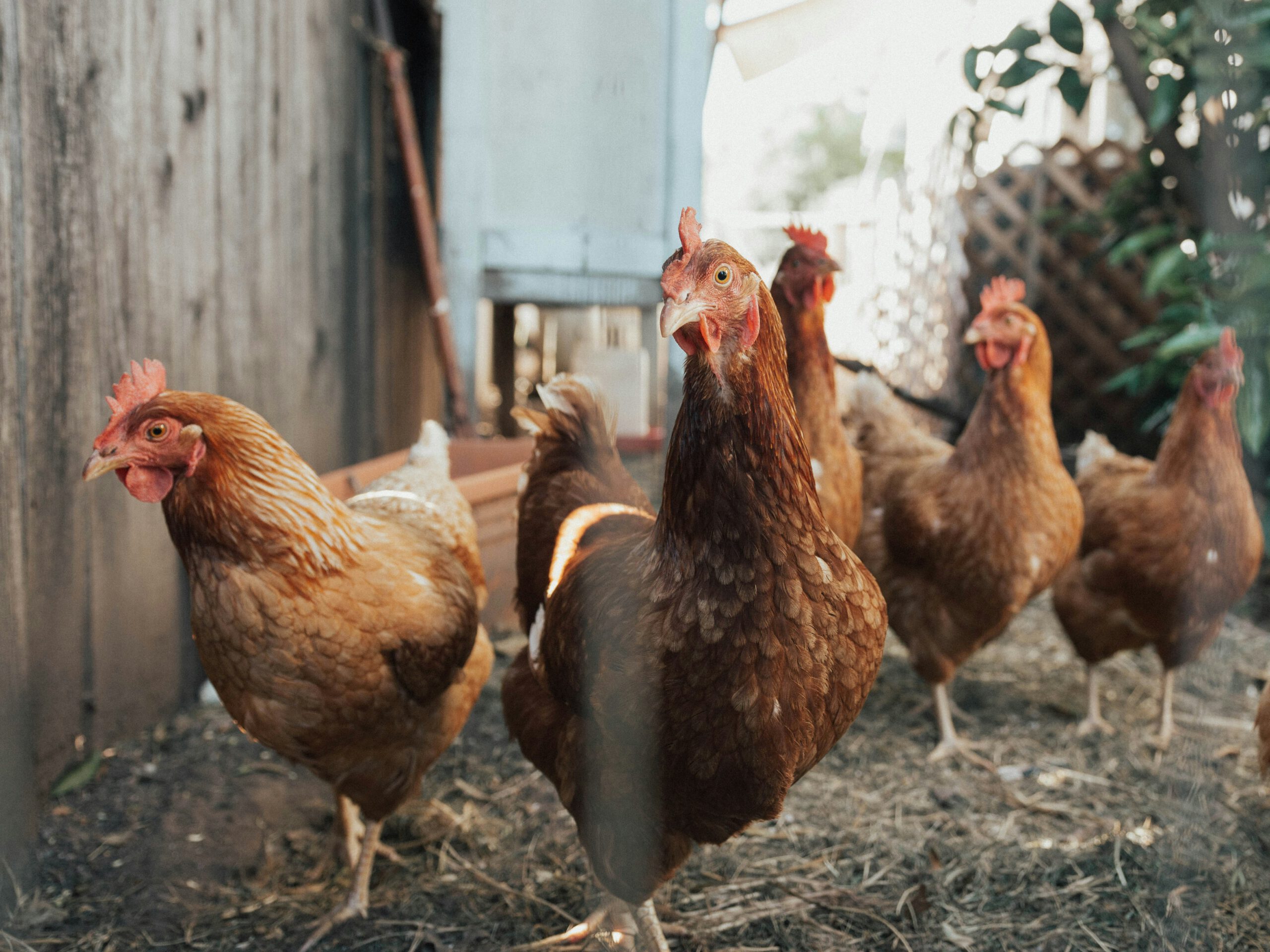
Meat chickens
Keeping chickens for meat is popular with smallholders and crofters, and many people in Scotland keep a couple of chickens in their backyards for personal use. Chickens can be kept alongside other livestock, combined with market gardening, and kept in a variety of spaces.
Updated 7 June 2026


Maintaining flock health
Everyone with chickens, regardless of whether you are a smallholder, crofter or a backyard keeper, has legal responsibilities to care for their health and prevent disease from spreading.
Before getting chickens, you have a legal duty to familiarise yourself with health guidance: read the Guidance for the Welfare of Meat Chickens and Meat Breeding Chickens. You should also set up plans to manage chickens’ welfare, find a vet you can call on and know how to do a chicken health check.
If you live in a remote area, see the Highlands and Islands Veterinary Services Scheme for contacts of vets.
In addition, there are certifications which have stricter welfare requirements, including RSPCA Assured and organic, which affect how you can market your meat. When planning how to maintain your flock’s health, consider how the meat will be labelled for selling (see ’Labelling’).
Biosecurity plan
Biosecurity means setting up and following a plan of actions that reduce the risk of your birds getting disease and spreading it between themselves or beyond the flock.
Your biosecurity plan should include actions for:
- Reducing the risk of people, equipment and vehicles bringing in disease
- Reducing the risk of wild birds bringing in disease
- Reducing the risk of new chickens bringing in disease (see ’Adding chickens to your flock’).
- Regular cleaning of the chicken coop and managing the range (see ’Cleaning’)
- Controlling vermin
- Contingency planning in case of disease outbreaks, which may require chickens to be kept indoors (see ’Chicken diseases & parasites’)
- How to safely store and dispose dead birds and animal by-products (see ‘Dead birds’)
When planning biosecurity measures, check if you are in a Higher Risk Area for avian influenza.
If you have a small flock, your biosecurity plan can be quite simple but you should still have one. The Scottish Government have published a small flock keeper’s guide to biosecurity.
You should review your biosecurity plan regularly and have it ready for inspection (see, ‘Inspections’).
Read more:
- ‘Bird flu (avian influenza): how to prevent it and stop it spreading’, Defra & APHA
- Biosecurity and preventing welfare impacts in poultry and captive birds, Defra
- Notifiable Avian Disease Control Strategy for Great Britain, Defra
- ‘Disease prevention for livestock and poultry keepers’, Defra
Health & welfare plan
You should create a plan which outlines how you will care for your flock’s health and welfare throughout their lifetime. Your biosecurity plan will be part of this, but the health & welfare plan focuses on your chickens rather than controlling disease.
The health & welfare plan should cover regular flock inspections, vaccinations, treating disease and parasites and controlling feather pecking.
Create the health plan with your local vet and review it with them annually.
Chicken diseases & parasites
Chickens are affected by many diseases and parasites which can be lethal if not treated.
Many of the common diseases are related to the chickens’ diet and hygiene, and it is important to follow your biosecurity and health plans to prevent problems.
Check the health of your flock regularly. You must attend promptly to chickens that appear ill or injured and call the vet if they do not get better or get worse. Seriously unwell or injured chickens should be isolated if necessary to prevent additional suffering.
Loss of feathers may indicate that your chicken is unwell or suffering from feather pecking, but it may also be caused by their yearly moult.
The Poultry Keeper has published a useful overview of diseases and health problems affecting poultry.
Further resources:
- ’Common diseases in backyard poultry in Great Britain’, APHA
- ’Health and Diseases’, the Poultry Club
- ’Common Chicken Illnesses and What to Look For’, Keeping Chickens UK
Notifiable avian diseases
If you suspect that your chickens have any of the notifiable diseases, you are legally required to immediately tell your local APHA Field Services team by contacting them.
Register your flock with APHA to get notifications about outbreaks in your area (see ’Flock registration’) or sign up to alerts.
Control of notifiable avian diseases
To control notifiable avian diseases, the government can impose zones which requires bird keepers in certain areas to follow control measures like movement restrictions. These measures apply to you regardless of how many chickens you have.
Check the interactive map of control zones in Scotland.
If a notifiable disease is confirmed in your flock, all of your chickens will be culled and you will receive compensation, but this is only for non-diseased birds.
However, if you keep chicken breeds that are considered rare/at risk, you can apply for an exemption from culling. To do this, you must apply to APHA with a contingency plan for your breed at risk, which demonstrates that sparing your chickens will not undermine disease control.
Read more about control measures in the Notifiable avian disease control strategy for Great Britain.
Chicken parasites
Internal and external parasites are common for chickens, and can be very difficult to get rid of once established. You should familiarise yourself with the symptoms and know how to treat parasites early on.
Common chicken parasites include red mite, lice, and worms. Many parasites activate when temperatures rise in the spring, and you should be vigilant during this time.
To prevent parasites, ensure that your chickens have places to dust bathe to keep themselves clean and maintain good biosecurity, especially a clean pasture (see ’Cleaning’).
It may be necessary to treat your chickens with medicine to get rid of parasites – see ’Medicines’.
Read more:
Medicines
Sometimes it is necessary to medicate your chickens to prevent or cure disease. You should not use antibiotics routinely and only use them as prescribed by a vet, to avoid disease-causing bacteria becoming resistant to antibiotics.
You can legally use only veterinary medicines authorised by the Veterinary Medicines Directorate – see the directory of approved veterinary medicines. Some can only be prescribed by a vet, and organic certification may restrict which medicines you can use.
You must also keep records of any medicines used — see ’Keeping records’.
Read more:
Using veterinary medicines
Veterinary medicines can be hazardous to human health if handled incorrectly, and their safe use is controlled by law if you sell chicken meat. This applies to you if you are self-employed and to anyone else working at your holding.
Follow this guide by the Health and Safety Executive on how to use animal medicines safely and comply with your legal duties.
You must wait until the end of the withdrawal period specified in the product before eating or selling meat from your chickens. Read more about medicine residues on Food Standards Scotland.
Worming
Instead of using wormers routinely, it is a good idea to test your chickens regularly for worms to check if they need to be wormed. You can do this by buying a worm egg count kit which is sent to a laboratory for testing.
Vaccinations
Vaccinating your chickens is not legally compulsory, but can be used to prevent and control some diseases. Usually, vaccination can only be done to very young chicks and poultry vaccines often come in large batches of over 500 doses which can make them impractical for small flocks.
Common chicken vaccinations include:
- Marek’s Disease
- Infectious Bronchitis (IB)
- Avian Rhino Tracheitis (ART)
- Mycoplasma gallisepticum (MG)
- Salmonella
When introducing new chickens to your flock, check if the breeder has given them any vaccinations. Do not mix vaccinated and unvaccinated birds.
It is illegal to vaccinate your birds against avian influenza without a permission from the government.
Find out more about chicken vaccinations:
Feather pecking
Feather pecking is an abnormal behaviour for chickens, where they peck and eat the feathers of other birds. It can develop into cannibalism, which other birds can learn and spread through the flock, so it is important to recognise and address feather pecking early on.
Feather pecking can occur in any chicken rearing system, but risk factors include lack of space, large flock sizes, boredom and inadequate nutrition.
Beak trimming is prohibited except as a last resort to prevent feather pecking and cannibalism, and only on veterinary advice, by trained staff, using approved methods. It is not permitted in organic systems. (see ’Mutilations’).
Read more:
Mutilations
Mutilating your chickens is defined as removing or damaging sensitive parts of their body, and is prohibited by law.
Trimming your chickens’ beaks only to control feather pecking is legally permitted, but organic certifications may ban it.
- If you have 500 chickens or more, beak trimming is legally allowed only on chicks less than 10 days old and with infra-red technology, unless it is an emergency measure to treat feather pecking.
- For smaller flocks, beak trimming should only be used as an emergency measure.
Clipping your chickens’ wing feathers to prevent them from flying is not considered mutilation, though this is generally not necessary for meat chickens.
Euthanising/culling chickens
Chickens may be slaughtered for various reasons, such as emergency slaughter of a critically ill or injured chicken or culling chickens.
You do not need a licence to carry out euthanasia or culling yourself, as long as this is done on your farm/croft, by yourself. Animal welfare must remain a priority and slaughter must be humane. Meat from chickens culled through home slaughter can only be eaten by you and your immediate family – it cannot be sold or given away to others.
If you want to use another method or sell meat from your chickens, the person slaughtering the chickens must have a Certificate of Competence and it must be done on an approved premises (see Transport & Slaughter).
It is an offence to cause avoidable suffering to an animal when slaughtering it, and only a competent person should do this. When slaughtering chickens, they must first be stunned and then killed before they regain consciousness.
The Humane Slaughter Association has practical guidance for ethical slaughter of poultry and guide on practical slaughter of poultry for smallholders. If you have any questions about slaughtering your chickens, contact Food Standards Scotland.
Read more:
- ’Slaughtering poultry’, Accidental Smallholder
- ’Home slaughter’, Food Standards Scotland
- ’Slaughter’, Food Standards Scotland
Chicken carcasses & waste
Chicken carcasses, parts and other material coming from your birds that is not meant for humans to eat is called animal by-products. The disposal of animal by-products is legally regulated depending on their health risks.
This means that you cannot dispose of carcasses or chicken manure as general waste. They must be sent for disposal by an authorised business, or you have some options for disposing them yourself.
- Carcasses must be collected by an approved knacker, hunt kennel, maggot farm, incinerator, or renderer. You can make your own arrangement with the collector or use the National Fallen Stock Company which connects farmers/crofters and collectors. If you are in a remote area, you are also allowed to burn or bury them.
- Manure can be composted or anaerobically digested. You can also spread it on land if you follow precautions for botulism, and you must stop farm animals grazing on this land for 21 days after (or two months for pigs).
More details and instructions about different animal by-products is published by Defra.
Fallen livestock reporting & disposal
Dead livestock must be disposed of appropriately. In most of Scotland, they cannot be buried or burnt in the open because of the risk of disease spread through groundwater or air pollution. Fallen stock must be disposed without ‘undue delay’ (usually within 48 hours of death). There are a number of disposal options available.
Some remote areas of Scotland have been granted exception to bury dead animals if other disposal options are not available. For more details of the areas and methods of disposal please see the guidance.