
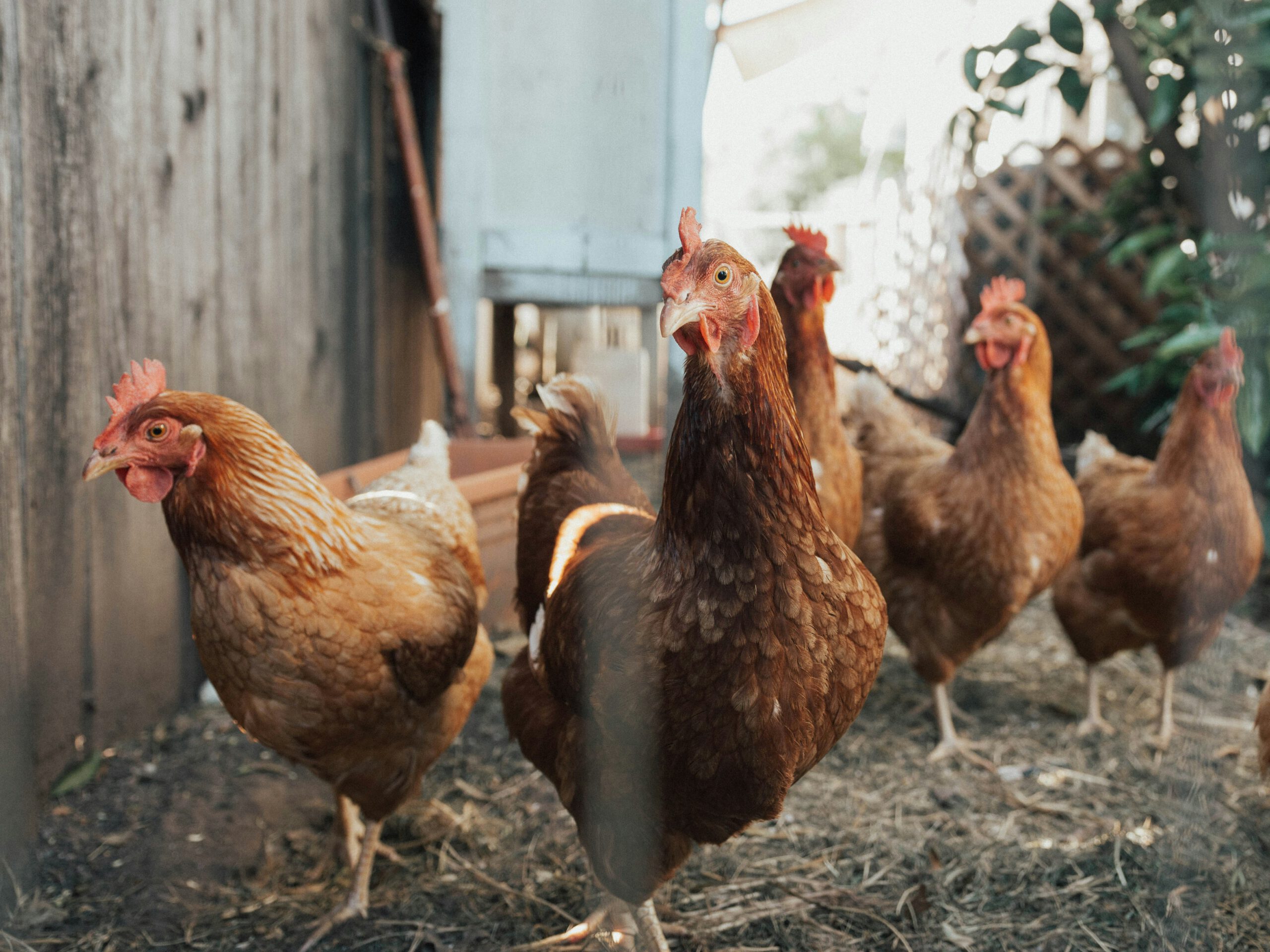
Meat chickens
Keeping chickens for meat is popular with smallholders and crofters, and many people in Scotland keep a couple of chickens in their backyards for personal use. Chickens can be kept alongside other livestock, combined with market gardening, and kept in a variety of spaces.
Updated 7 June 2026


Establishing a chicken coop
When starting out with chickens for meat production, decide whether you want to rear them organically, free ranging or in a barn.
Each of these systems comes with legal minimum requirements which determine how you can market the meat. Management considerations for meat chickens are specific, as they grow quickly and spend most of their time on the floor rather than perching. Careful attention should be paid to litter management and stocking density to avoid leg problems and breast burns.
If you want to sell your meat as organic you will need to be certified by one of the UK organic certification bodies. The requirements vary slightly between the different bodies, as some set standards higher than the EU baseline. The key requirements for organic chickens in terms of welfare are plenty of space inside and out and ready access to the outdoors (unless local or national restrictions are in place). Beak trimming is not permitted in organic flocks.
You are expected to source organic day-old chicks, but you can ask for an exemption if none are available. As with other organic livestock you can only feed your chickens organic feed.
Site selection
When selecting a site for a chicken coop, consider how many chickens you want to keep and whether you will provide them an outdoor range. You should also consider the biosecurity risks of the site — check if you are in a Higher Risk Area for avian influenza.
You are legally required to ensure that your flock has a suitable environment, meaning that your chickens must have:
- Enough space to move both outdoors and indoors. Total live weight must not exceed 33kg per m2 of usable area. Organic and free-range systems generally have lower live-weight limits.
- Adequate shelter (see ’Housing & fencing’).
- A sufficient diet. If your chickens feed by foraging, consider how to manage the foraging area and their diet for enough nutrients (see ’Feeding & watering chickens).
- Protection from predators, for example by supervision or fencing (see ’Housing & fencing’)
Restrictions on keeping chickens
Before committing to a site, consider nuisance to your neighbours especially in urban areas.
Disturbed neighbours may file a statutory nuisance complaint to the local council — read more about statutory nuisance.
You should also check if keeping chickens is restricted on the property (this can differ for hens and cockerels):
- Councils: Check with the local council that they do not have any by-laws that restrict the keeping of chickens.
- Your property: Check the deeds of your property for any restrictive covenants that may prohibit the keeping of chicken.
- Rented property: Check if your contract allows keeping livestock.
Housing & range
You must provide your chickens with access to shelter, a comfortable resting area, food and water, as well as protect them from predators. If you want to produce organic meat, you need to provide your chickens an outdoor pasture. You will also need feeding and watering equipment.
Coops & housing
Coops must comply with the requirements noted in the welfare of meat chickens and meat breeding chickens guidance
Key requirements for chicken housing include:
- Easy access to inspect the birds and clean the space at any time.
- Materials are safe to come into contact with chickens, have no sharp edges that can cause injury and can be thoroughly cleaned.
- Protection from draughts and heat and cold stress.
- Good ventilation and sufficient light.
- Excludes vermin and predators, and prevents parasite infestations.
Read more:
- ’The chicken house’, Poultry Keeper
- ’Poultry Housing’, Accidental Smallholder
- ’Poultry Housing’, Farm Health Online
Outdoor range
Having access to outdoors benefits the welfare of your flock and for some certifications, such as organic, providing an outdoor range for chickens is mandatory.
You can let your chickens range free or keep them in an enclosed run.
- Forage: When foraging, chickens will dig up the ground and eat plants. Some common plants are poisonous to chickens, and they are also susceptible to agrochemicals such as herbicides. Read about things that are toxic to chickens on the Open Sanctuary Project.
- Soil quality: If used by too many chickens, ground within the range area can break down and become muddy or infested with parasites from the birds’ droppings, which can cause environmental and health issues. You should avoid this by rotating the location of the range/run or resting parts of it in turns.
- Safety: Chickens can be injured by farm machinery and predated on by other animals. You must provide your flock some overhead shelter when outdoors (such as trees), ensure access to water and a dry resting area, and consider how to keep wild birds away from their feed and water to avoid spread of avian influenza.
Planning permissions
You do not need planning permission if the chicken housing or fence complies with the permitted development rights for the property, which are regulated by your local planning authority.
Chicken housing less than 465m² in size and under 12 metres in height is usually allowed within permitted development rights, unless your farm holding is less than 0.4 hectares.
Fencing higher than 2 metres, or higher than 1 metre within 20 metres of a road, will need planning permission.
Check permitted development rights for private dwellings and agricultural operations in Schedule 1 of the Town and Country Planning (General Permitted Development) (Scotland) Order 1992. Additional restrictions may apply near listed buildings and in areas of conservation designation.
Before building housing or fencing, it is advisable to confirm permissions with your local planning authority.
Find out more:
Your flock
When planning your flock, consider target slaughter weight, growth rate, housing capacity and processing arrangements. Meat chickens are typically reared in a single batch and slaughtered at the same age to simplify management and biosecurity.
Breed choice will affect growth speed, feed use and suitability for free-range or organic systems.
Breed selection
Different chicken breeds are adapted to different environments and often intended for either meat or egg production. For meat production, choose breeds selected for appropriate growth rate and carcass quality. Organic and higher-welfare systems often require slower-growing breeds.
Breed choice may be restricted by what is on offer in your area, and you should research options before purchase.
Read more:
- ’Chicken Breeds’, Poultry Keeper
- Chicken breeds, The Poultry Club
- Chicken breeds watchlist, Rare Breeds Survival Trust
Sourcing chickens
Meat chickens are usually purchased as day-old chicks from hatcheries or breeders.
Where possible, collect the birds yourself so you can inspect their living conditions and health, and ask for health documentation such as vaccination records. The Open Sanctuary Project has published a guide on how to conduct a chicken health check.
Read more:
Adding chickens to your flock
Typically meat chickens are reared in single-age flocks. If new chickens are introduced, they should be quarantined for at least two weeks before slowly introducing them to your flock.
Quarantining chickens is not a legal requirement in Scotland, but will reduce the risk of disease and parasite spread. Flocks also have a pecking order, and introducing new chickens without due care can cause behavioural problems such as violent bullying especially affecting younger birds.
You should not mix vaccinated and unvaccinated birds (see ’Vaccinations’).
Read more:
’Introducing New Chickens to Your Flock’, Poultry Keeper