
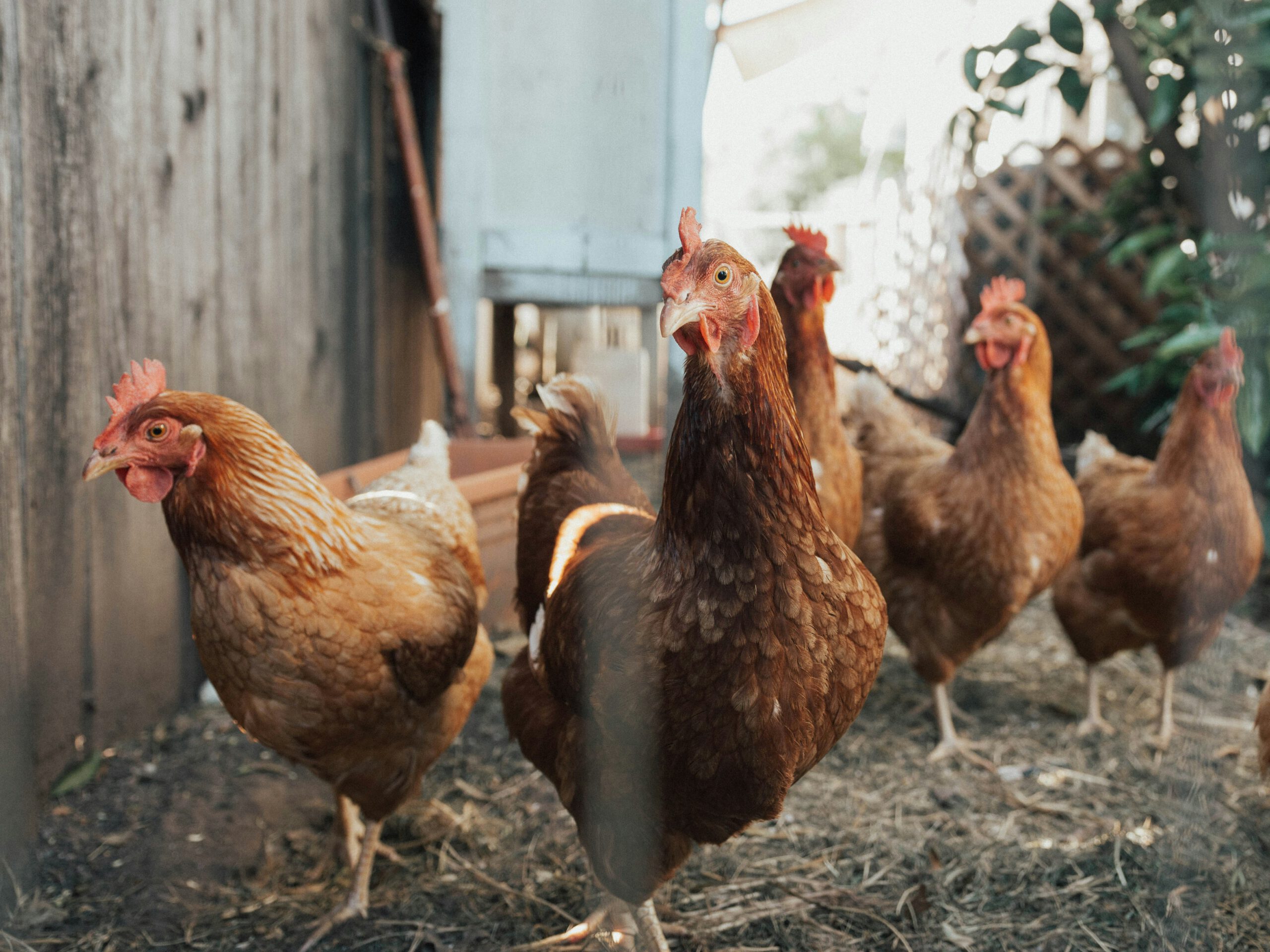
Meat chickens
Keeping chickens for meat is popular with smallholders and crofters, and many people in Scotland keep a couple of chickens in their backyards for personal use. Chickens can be kept alongside other livestock, combined with market gardening, and kept in a variety of spaces.
Updated 7 June 2026


Preparing meat for sale
Meat
If you want to process and sell chicken meat, you need to be registered as a food business and your premises approved by your local authority (see ‘Feed business registration’).
If you plan only to sell directly to customers or to local retailers then your premises must be registered and approved by the local authority, Food Standards Scotland approval is not required.
You can either employ a butcher to come to your farm, or butcher the meat yourself — you do not need a licence for this, but it is useful to take a butchering course. Many different organisations run these, like Scottish Craft Butchers.
Your cutting room will need to meet specific requirements laid down in regulation. In particular, to maintain product below 7 degrees for meat and 3 degrees for offal; facilities for handwashing and for separation of products at different stages. You also need to ensure that carcasses brought back from the abattoir are maintained at a low temperature.
You will need to set up a Food Safety Management System using Hazard Analysis and Critical Control Points (HACCP). See here for guidance on developing your system.
Butchery waste is legally classified as an animal by-product (see ’carcasses & waste’). You must handle it carefully, as it can pose a serious risk to human health.
Read guidance on safely handling and disposing animal by-products on gov.uk
Packaging
You must only package meat in materials which are approved for being in contact with food. Read the legislation on packaging materials.
You will also need commercial scales to weigh your produce and comply with legal rules around packing and weight of the produce.
Meat must be wrapped hygienically and securely in approved material. See the FSS guide on ’Wrapping, Packaging and Transport Hygiene’ of meat.
Labelling
To sell meat, you must comply with labelling regulations ensuring that customers are being given correct information and the product can be tracked through the supply chain.
Labelling requirements depend on how the meat is packaged and who you sell it to.
Read about additional labelling requirements for frozen products.
If you are selling directly to customers you must label the product with:
- Name of the food
- Ingredients list including allergenic ingredients in bold
If you are making products with your meat – e.g. pies – you will also need a quantitative ingredient declaration (QUID).
Read guide on labelling pre-packaged food for direct sale by FSS.
Prepacked for onward sale
Meat that is securely packaged before it is sold to retailers who sell it to customers has additional labelling requirements:
- Use-by date
- Name and address of your farm/croft business
- Storage instructions (e.g., ’Keep refrigerated’)
- Preparation instructions (if needed)
- Identification mark
Read more about ’Meat labelling guidance’, FSS